
Abu Simbel Temples: A Monumental Marvel of Ancient Egypt
Nestled in the southern region of Nubia, near the modern-day border of Sudan, the Abu Simbel Temples stand as a remarkable testament to ancient Egyptian civilization. Commissioned by Pharaoh Ramses II in the 13th century BC, these rock-cut temples are widely recognized as some of the most magnificent architectural achievements of the New Kingdom period. They combine political symbolism, religious devotion, and artistic brilliance in a way that has captivated scholars, travelers, and adventurers for centuries.
The temples’ primary purpose was both spiritual and political: to honor the gods of Egypt and to assert the Pharaoh’s dominance over the Nubian territories. Carved directly into the sandstone cliffs overlooking the Nile, Abu Simbel’s imposing presence demonstrates the Pharaoh’s divine authority while serving as a strategic statement of power.
The site consists of two main temples: the Great Temple of Ramses II, dedicated to the Pharaoh and major deities, and the Smaller Temple of Queen Nefertari, honoring Ramses’ chief queen. Together, they showcase ancient Egyptian artistry, religious devotion, and engineering prowess, remaining a cornerstone of Egypt’s historical and cultural identity.
abu simbel temples Historical Background
Ramses II: The Pharaoh Behind Abu Simbel
Ramses II, often called Ramses the Great, reigned from 1279 BC to 1213 BC, marking one of the longest and most prosperous periods in Egyptian history. Known for his military campaigns, monumental constructions, and strong leadership, Ramses II is remembered as one of Egypt’s most powerful and celebrated Pharaohs.
Abu Simbel was commissioned after Ramses II’s victory at the Battle of Kadesh, symbolizing both military triumph and divine favor. The temples reflect his ambition to immortalize his reign, project Egypt’s supremacy, and strengthen his connection with the gods. Ramses II’s divine image is immortalized in the colossal statues, hieroglyphs, and intricate reliefs throughout the temples, conveying his eternal presence to both subjects and enemies.
Political and Religious Significance served multiple strategic and ceremonial purposes:
- Political Symbolism: The temples were strategically built near Nubia to project Egyptian dominance and influence in the region.
- Religious Center: Dedicated to gods such as Ra-Horakhty, Amun, and Ptah, the temples reinforced Pharaoh’s divine status.
- Cultural Legacy: The temples embodied Egyptian artistic, engineering, and religious excellence, leaving an enduring legacy for future generations.
Architectural Marvels of the Great Temple
The Exterior: Colossal Statues and Monumental Facade
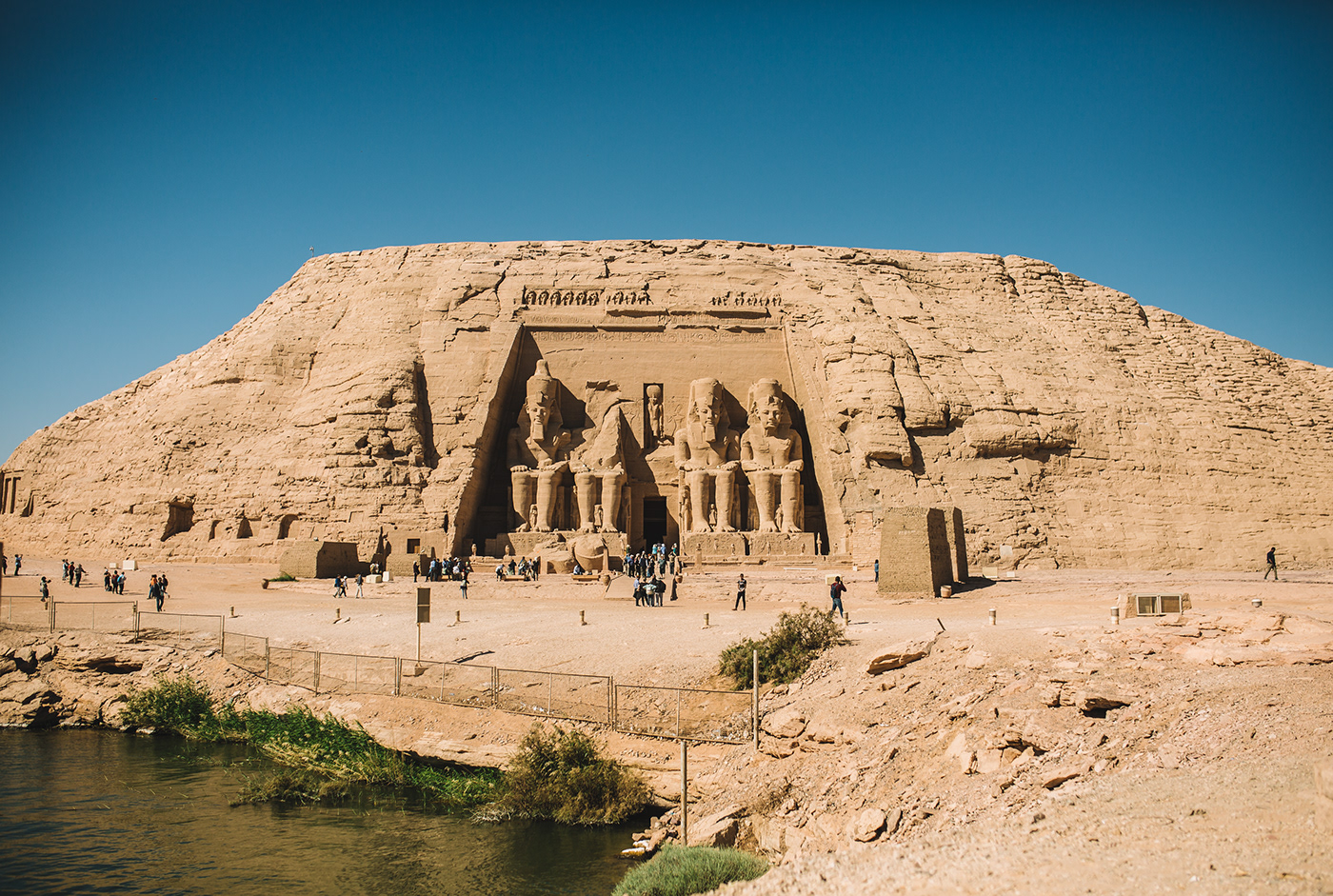
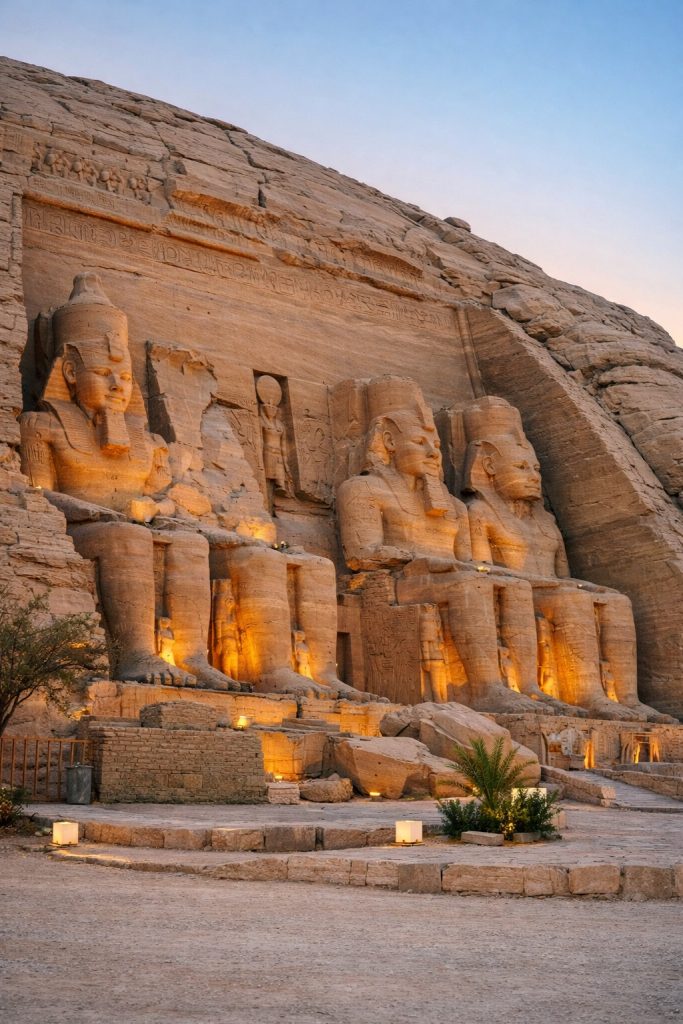
The Great Temple is renowned for its imposing facade, dominated by four colossal statues of Ramses II, each approximately 20 meters tall (66 feet). These statues depict Ramses seated on his throne, exuding strength and divine authority. Flanking the Pharaoh are smaller statues of his family members, including his wife, children, and mother, emphasizing the dynastic and familial importance of his reign.
The temple’s facade is not only visually stunning but also symbolic. Each statue was carefully positioned to project power to the approaching visitor, while the inscriptions and reliefs celebrate the Pharaoh’s achievements, both militarily and spiritually.
Interior Layout and Artistic Mastery
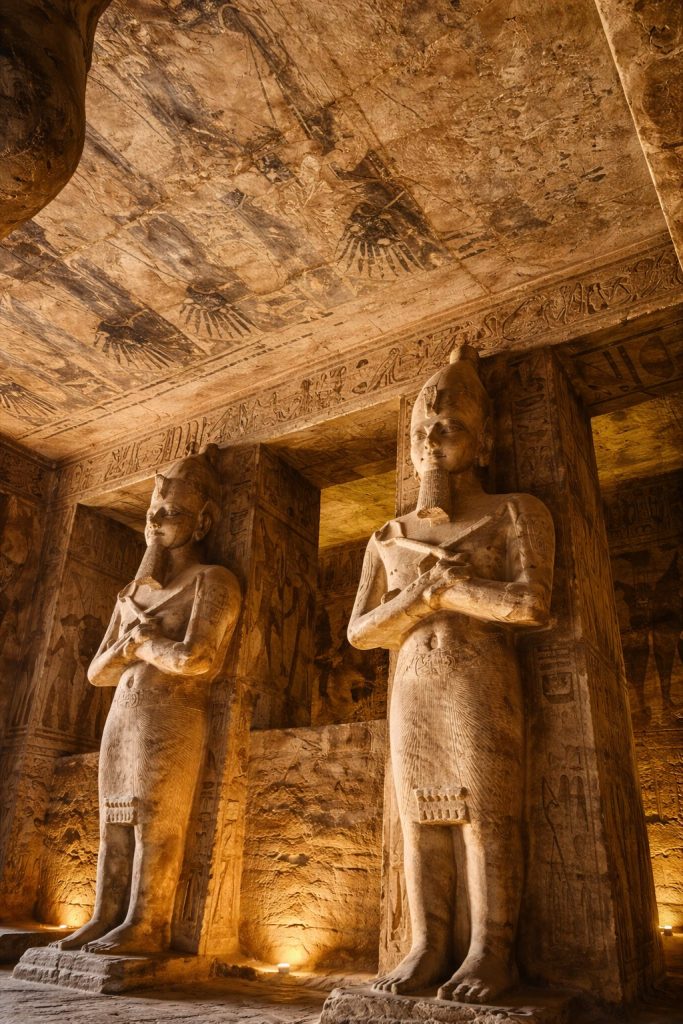
Inside the Great Temple, visitors pass through a series of halls and chambers leading to the inner sanctuary. The walls are covered with detailed bas-reliefs, depicting Ramses II’s victories, religious ceremonies, and divine encounters. Scenes from the Battle of Kadesh, one of the Pharaoh’s most famous military campaigns, adorn the walls in meticulous detail, highlighting Egyptian strategies, chariots, and soldiers.
The inner sanctuary houses four statues representing Ramses II and major gods. Twice a year, on February 22 and October 22, sunlight penetrates the temple’s entrance to illuminate the sanctuary statues in a phenomenon known as the solar alignment, believed to coincide with Ramses II’s birthday and coronation. This remarkable alignment showcases the Egyptians’ astronomical knowledge and architectural precision.
abu simbel temples Engineering and Construction Techniques
Carving a temple of this magnitude directly into sandstone cliffs required sophisticated planning and skilled labor. Ancient Egyptian engineers considered structural stability, orientation to the sun, and intricate relief placement. The precision with which the colossal statues and internal chambers were created continues to astonish modern architects and archaeologists.
The Temple of Queen Nefertari
Dedication and Symbolism
The smaller temple, often referred to as the Temple of Hathor, was dedicated to Queen Nefertari, Ramses II’s chief consort. The facade features six statues, with four representing Ramses II and two representing Nefertari, a rare honor that underscores her significance. The temple’s interior walls depict Nefertari performing rituals and worshiping Hathor, the goddess of love, beauty, and fertility.
Artistic Brilliance
This temple highlights feminine divinity, royal devotion, and aesthetic finesse. Its colorful reliefs, symmetry, and detailed carving demonstrate the Egyptians’ skill in proportion and design. Unlike the grandiose scale of the Great Temple, the Temple of Nefertari focuses on intimate spiritual devotion, offering insights into the Pharaoh’s personal life and his reverence for his queen.
Relocation of Abu Simbel: Saving a Global Treasure
Threat from Aswan High Dam
In the 1960s, the construction of the Aswan High Dam threatened to submerge Abu Simbel under the rising waters of Lake Nasser. Recognizing the temple’s cultural and historical significance, UNESCO launched an international campaign to relocate the monuments.
abu simbel temples Engineering Feat and International Collaboration
The relocation project involved cutting the temples into massive blocks weighing up to 30 tons, meticulously moving them to higher ground, and reconstructing them to retain original orientation and alignment. This endeavor, involving engineers, archaeologists, and workers from multiple countries, preserved not only the structures but also their intricate carvings and solar alignment.
The successful relocation stands as one of the 20th century’s most remarkable feats of archaeological preservation, ensuring Abu Simbel remains accessible for future generations.
Abu Simbel: A Modern Traveler’s Guide
abu simbel temples Best Time to Visit
Tourists should aim to visit between October and April, when temperatures are moderate. Witnessing the solar phenomenon offers a unique, once-in-a-lifetime experience.
abu simbel temples Travel and Accessibility
Visitors can reach Abu Simbel via air from Aswan, by organized road trips, or through Nile cruise tours that include stops at southern Egyptian landmarks. Local guides enhance the experience with historical context, legends, and insights into architectural techniques.
abu simbel temples Practical Tips for Tourists
- Dress Modestly: Respect local customs and protect against the desert sun.
- Photography: While the exterior is open for photography, interior sanctuaries require adherence to preservation rules.
- Timing: Arrive early to avoid the crowds, especially during peak tourist seasons.
abu simbel temples Cultural and Global Significance
Abu Simbel is not just an archaeological site—it is a symbol of human ingenuity, artistic mastery, and cultural preservation. Its temples have inspired books, films, and documentaries worldwide. Scholars study Abu Simbel to understand Egyptian engineering, religious rituals, and dynastic politics.
The temples’ relocation is celebrated as a landmark achievement in global heritage preservation, showing how international cooperation can save humanity’s most precious cultural treasures.
abu simbel temples Modern Popular Culture
From travel documentaries to historical novels, Abu Simbel captivates audiences worldwide. Its dramatic relocation, colossal statues, and mysterious solar alignments have inspired awe in engineers, historians, and travelers alike. The site is a staple in discussions of Egyptian antiquities, appearing in films, exhibitions, and cultural festivals celebrating ancient history.
Abu simbel temples Timeless Monument
Abu Simbel Temples remain a living testament to Egypt’s golden age. The grandeur of Ramses II’s Great Temple and the intimate beauty of the Temple of Nefertari capture the essence of ancient Egyptian civilization. Beyond their historical and artistic significance, these temples embody human creativity, engineering brilliance, and spiritual devotion.
Visitors leave with a profound sense of wonder, inspired by the skill, vision, and cultural legacy of a civilization that continues to shape the world’s understanding of history and artistry. The temples, preserved through modern engineering feats, stand ready to educate, inspire, and awe generations to come.