Temple of Philae Is One of Egypt’s Most Magical Monuments
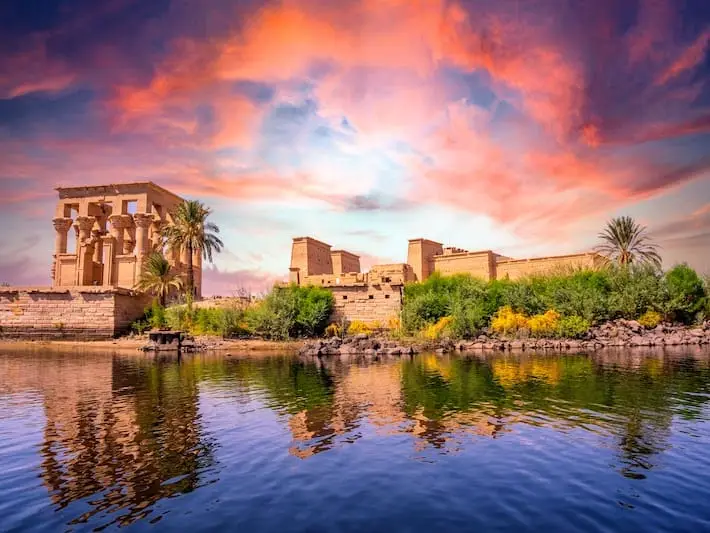
The Temple of Philae in Aswan is not just an ancient Egyptian temple. It is a story of faith, power, mythology, survival, and international rescue. Standing gracefully on Agilkia Island in the Nile River, this magnificent temple complex dedicated to the goddess Isis remains one of the most romantic and spiritually captivating archaeological sites in Egypt.
For travelers exploring Aswan tourist attractions, Philae Temple is considered a must-visit destination. For historians and archaeology lovers, it represents the final chapter of ancient Egyptian religion. And for photographers, it is one of the most picturesque ancient Egyptian temples ever built.
This complete guide explores the history of Philae Temple, its architecture, religious significance, UNESCO rescue mission, myths of Isis and Osiris, and essential travel tips for visitors.
Where Is the Temple of Philae Located?
Location in Aswan
The Temple of Philae is located in southern Egypt, near the city of Aswan. Today, the temple stands on Agilkia Island, a small island in the Nile River.
Originally, however, the temple was constructed on Philae Island itself. Due to the construction of the High Dam of Aswan in the 20th century, the temple faced submersion under the waters of Lake Nasser.
How Visitors Reach Philae Temple
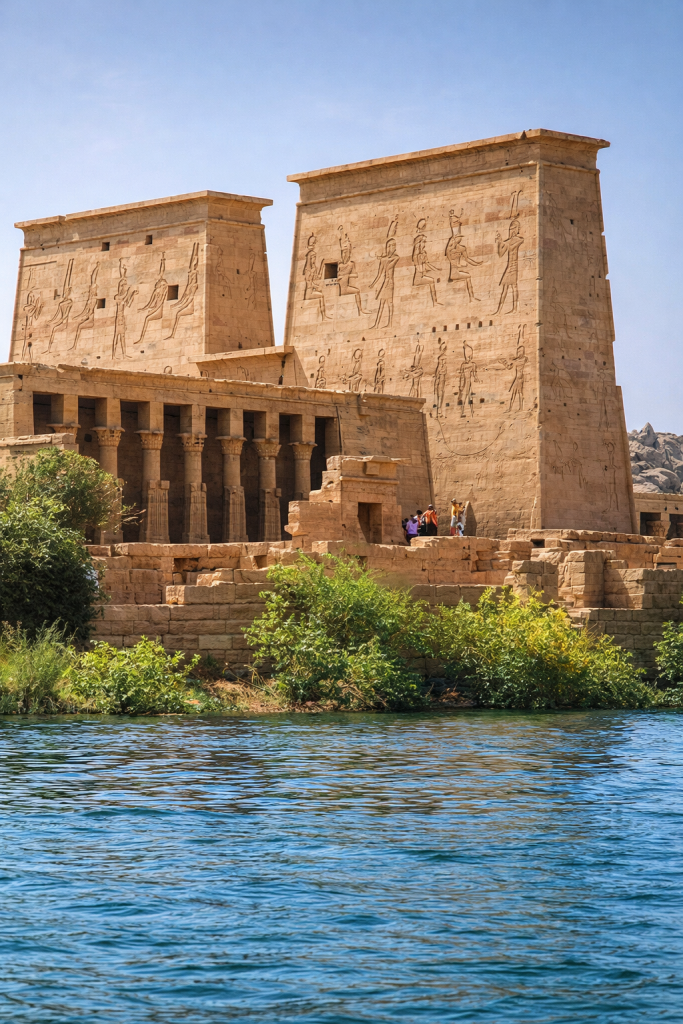
Visitors reach the Temple of Philae by taking a motorboat from the marina near the temple entrance. This short Nile ride enhances the mystical atmosphere, as the temple gradually appears like a mirage rising from the water.
The boat journey is not just transportation — it is part of the full Philae Temple experience.
The Historical Timeline of Philae Temple
Early Foundations and Sacred Significance
Although most of the visible structures belong to the Ptolemaic period, the island of Philae was considered sacred long before that. It was believed to be one of the burial places of Osiris.
Philae became a major religious center, especially for the worship of Isis.
The Ptolemaic Construction Period
The main construction of the Temple of Philae began during the reign of Ptolemy II Philadelphus (285–246 BCE). Greek rulers of Egypt adopted traditional Egyptian architectural styles to legitimize their authority.
Subsequent Ptolemaic kings expanded the complex, adding pylons, courtyards, and chapels.
Roman Additions
Roman emperors such as Augustus, Tiberius, and Trajan also contributed to the expansion of Philae Temple. The famous Kiosk of Trajan remains one of the most elegant Roman additions.
The Last Stronghold of Ancient Egyptian Religion
Philae Temple was one of the final places where ancient Egyptian religion survived after Christianity spread across Egypt.
Worship of Isis continued here until the 6th century AD, when Byzantine Emperor Justinian ordered the closure of pagan temples.
Later, parts of the temple were converted into a Christian church, leaving visible crosses carved into ancient walls.
The Goddess Isis and Her Sacred Temple
Who Was Isis?
Isis was one of the most important goddesses in ancient Egyptian mythology. She symbolized motherhood, healing, magic, protection, and divine femininity.
She was the wife of Osiris and the mother of Horus.
The Myth of Isis and Osiris
According to Egyptian mythology:
- Osiris was murdered by his brother Set.
- His body was cut into pieces and scattered.
- Isis traveled across Egypt to collect and reassemble his body.
- Through her magical powers, she resurrected him long enough to conceive Horus.
Philae became the spiritual center of this myth.
Pilgrims traveled from across Egypt and Nubia to worship Isis at her sacred island temple.
Architectural Highlights of the Temple of Philae
The First Pylon
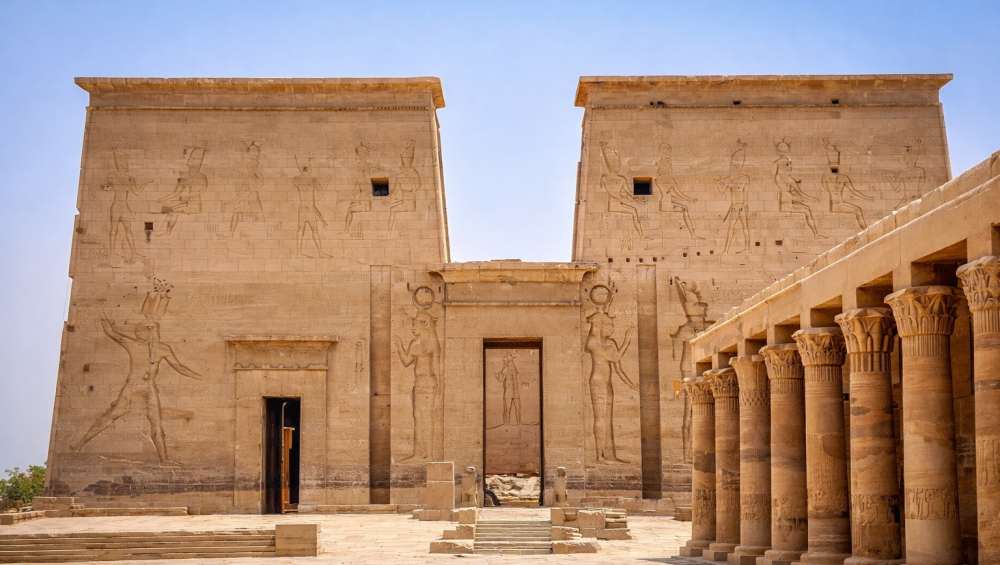
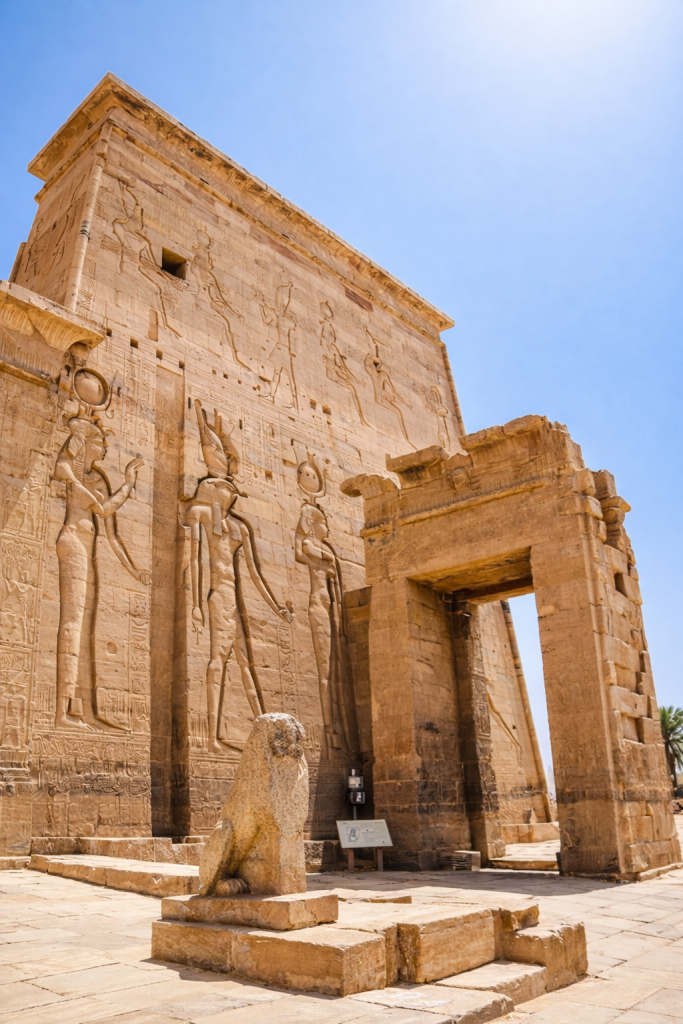
The entrance of Philae Temple is marked by a massive pylon decorated with reliefs showing the king defeating enemies before Isis and Horus.
These carvings symbolize divine protection and royal authority.
The Forecourt
Beyond the pylon lies an open courtyard surrounded by colonnades. The floral column capitals represent lotus and papyrus plants — symbols of Upper and Lower Egypt.
The Hypostyle Hall
The Hypostyle Hall contains beautifully carved columns and detailed reliefs showing religious rituals, offerings, and sacred ceremonies.
Hieroglyphics here provide valuable insight into ancient Egyptian religious practices.
The Sanctuary of Isis
The sanctuary was the most sacred chamber of the temple. Here stood the statue of Isis, accessible only to high priests.
This inner chamber symbolized the spiritual heart of Philae Temple.
The Kiosk of Trajan
One of the most iconic structures within the complex is Trajan’s Kiosk. This elegant open pavilion reflects Roman architectural influence while maintaining Egyptian style.
The UNESCO Rescue Mission: Saving Philae Temple
The Threat of Flooding
With the construction of the Aswan High Dam in the 1960s, many Nubian monuments were threatened by rising waters.
Philae Temple was partially submerged for months each year.
The International Campaign
In 1960, UNESCO launched a global rescue mission to save Nubian monuments, including Abu Simbel and Philae.
Between 1972 and 1980:
- The temple was dismantled into over 40,000 blocks.
- Each stone was carefully numbered.
- The complex was reconstructed on Agilkia Island at a higher elevation.
This project remains one of the greatest archaeological preservation efforts in history.
Philae Temple in the Greco-Roman World
The worship of Isis spread far beyond Egypt.
Temples dedicated to Isis were found in:
- Rome
- Greece
- Spain
Philae became an international religious center during the Greco-Roman era.
The blending of Egyptian and classical influences is visible throughout the temple’s architecture.
Religious Symbolism in the Temple of Philae
Philae Temple is rich in symbolic imagery.
Common symbols include:
- The ankh (symbol of life)
- The throne symbol of Isis
- Solar disks
- Sacred boats
These symbols reinforced the temple’s spiritual meaning.
Sound and Light Show at Philae Temple
At night, Philae Temple hosts one of the most enchanting Sound and Light Shows in Egypt.
The illuminated temple walls and dramatic narration recount the story of Isis and Osiris.
For many visitors, this experience is the highlight of their Aswan trip.
Best Time to Visit Philae Temple
Weather Considerations
Aswan has a hot desert climate.
The best months to visit are:
- October
- November
- February
- March
Early morning and late afternoon visits are recommended.
Photography Tips
Sunset offers golden reflections on the Nile, making Philae Temple one of the most photogenic sites in Egypt.
Travel Tips for Visiting Philae Temple
- Wear comfortable shoes.
- Bring sunscreen and water.
- Hire a licensed guide for deeper understanding.
- Combine your visit with Abu Simbel and the Nubian Museum.
- Allocate at least two hours for full exploration.
Why Philae Temple Is a Must-Visit Attraction in Aswan
Philae Temple combines:
- Ancient mythology
- Ptolemaic and Roman architecture
- Christian history
- UNESCO preservation success
- Stunning Nile scenery
Few monuments in Egypt offer such a complete historical narrative.
Conclusion: The Timeless Legacy of Philae Temple
The Temple of Philae is more than an archaeological site.
It is a symbol of:
- Devotion
- Survival
- Cultural continuity
- International cooperation
From the worship of Isis to its dramatic relocation, Philae Temple remains one of Egypt’s most powerful historical landmarks.
For anyone planning an Egypt travel itinerary, the Temple of Philae in Aswan should be at the very top of the list.